Professor S.O. Abdulraheem, Former VC of UNILORIN and One-time Chair of FCC, is 78 Years Old This Year
 pristinegist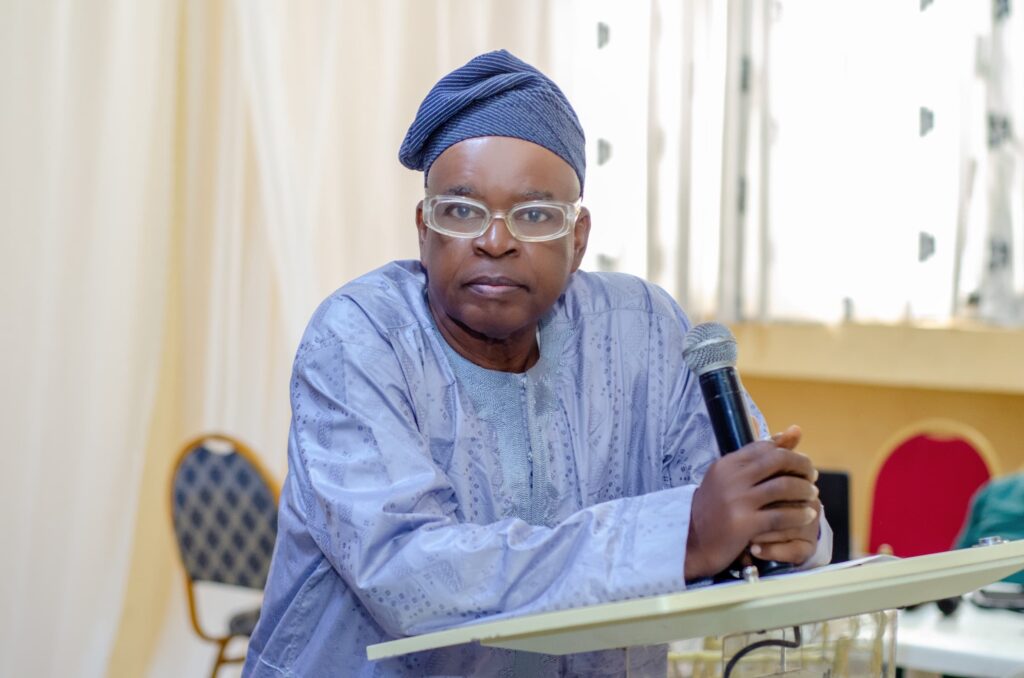
On October 22, 2025, our beloved teacher and mentor, Prof. Shuaibu Oba Abdulraheem, celebrated his 78th birthday. Time flies! Just a few years ago, some people made a big fuss about his age when he became Vice-Chancellor of the University of Ilorin at 49. Now, he is approaching octogenarian status—gratitude to Almighty Allah for the health of life.
Prof. Abdulraheem’s educational journey began with elementary school in Ilorin, followed by secondary education in Minna, and later, a BA in English at ABU’s Kano campus. On scholarship, he earned his doctorate from the University of Sheffield in the early 1980s. Upon returning, he rose rapidly through the ranks at Bayero University Kano, becoming a Professor in 1995 (backdated to 1993).
I had the privilege of meeting him in December 1982 in Kano. My brother, Alhaji Isiaku Onitada, arranged the meeting with one of his friends. When we visited his house, he was excited about my academic performance and shared a story about a previous candidate who had exaggerated his credentials. He had said it in Yoruba that: “Emi oti gba ikan ti oso nitori pe Omo kan na wa si ile mi ni Ilorin ti apadari pe ikan ki ikan ni oni. Nitori re, omu iwe eri re wa kin fi oju arami ri.” (I have heard the good result that you said you have, but I would need to see it for me to believe your story).
After seeing the results, he was satisfied, and we then discussed the possibility of securing admission to BUK for me. After some discussions, we later struck a deal in which I would focus on my A-Level programme for 2 years before pursuing university education at BUK. Upon completing the HSC programme, I returned to him to update him on my progress. He congratulated me and advised me to study economics, given my distinction in the subject. However, I politely argued for political science, citing the complex mathematics in economics, which I was unsure I could handle. I had initially wanted to study law. However, the requirement for Arabic and the need to obtain an Arabic certificate led me to abandon that career path and pursue a degree in political science instead. Dr. Oba respected my decisions on both occasions.
Providence played a role in my gaining admission into BUK in 1984. On the day of my admission to the school, Dr. Oba Abdulraheem was travelling to Ilorin for the College of Education’s convocation. I met him as he was leaving the Department, and he called me over. We drove to the Dean of Social and Management Sciences’ office, where Dr. Ibrahim Kiyawa was the Dean. After some time, he emerged with excitement and said, “Hassan, go to Ilorin and tell your people that your name is among those admitted.” That intervention paved the way for my admission and also facilitated the admission of Abdullahi Omoiya, who was admitted to study sociology.
After discharging this duty for us, Dr. Oba drove straight to the airport, while I stayed back, going to campus every day until the admission list was released a week later. On the seventh day, the school authority posted the list of admitted candidates, and I found my name on it. I heaved a sigh of relief and thanked God and Dr. Oba for making it possible.
As I progressed in my studies, I kept Dr. Oba informed. He was delighted to learn that I had won the champion trophy. I retained it throughout my programme, eventually becoming the best overall graduating student in my set, although I missed the associated prize. However, there was an administrative practice during our time at the University. The physical screening of final-year students was mandatory, and, due to an oversight, my name, which had been forwarded as the award winner, was dropped because one of the results in contention might not be confirmed by the vetting committee. By the time I found out, it was a day before convocation, and there was nothing I could do except to apologise to those whom I had informed of the development. I consulted with my mentor, who laid out two possible scenarios and their implications. I chose not to protest officially, which would have led to sanctioning the officer responsible for the administrative lapse for failing to update the list of the award winners after I had been cleared.
In his view, protesting would have put me at odds with the Department in the future. So, I let it go. My decision to go to Ife for my master’s degree was not without his guidance. He carefully educated me on what I would become after obtaining a master’s degree in International Relations: Prof. Oba’s counselling turned me into a good student of International Relations. I am grateful to him.
As if Dr. Oba knew what the future held, I later pursued my PhD in the same Department at BUK. This time around, he was in an elevated position at the Postgraduate School. I registered and defended my project under his general supervision as the Dean. I completed the programme in less than three years, which delighted him after his initial concern that my acceptance of teaching responsibilities at BUK would distract me from the doctorate programme. When it was time for my defence, I had to wait for six months due to the ASUU strike and another six months were added by administrative processing, neither of which upset me in any way. On the eve of the defence, Dr. Oba interacted with the external examiner, Prof. Julius Okolo from UDUS, to ensure everything went smoothly and to confirm the story I had told him about that stage of my work. The external examiner must have told him more glowing things about the work than I had done. After the defence, I scored an excellent grade on all three criteria points. There were no issues, and I believe that not protesting earlier may have actually worked in my favour. At this point, I pray for the repose of my mother, who bore the entire cost of my education until she died in 2015.
In 1997, I came to Ilorin from my NDA, Kaduna base, which I joined in 1990 through the efforts of Alhaji Raimi Ajao Ishao and the late Air Commodore Ibrahim Adesina Abdulrahman. I had come home to commiserate with my mother over the death of our eldest sister. I seized the opportunity to congratulate Prof. Abdulraheem as the VC of Unilorin. Indeed, I stayed in his house, and the issue of an appointment with UNILORIN came up. Oga was the person who first raised it, apparently because I could give my support to him. The truth is that I did not initially want to come to UNILORIN after my failed attempt in 1989, which involved Alhaji Mudi Gold, Alhaji Amuda Alaya, Prof. Adeniyi, and Alhaji A. O. Alao.
Moreover, the then Registrar of the NDA, Lt. Col. Abdulrahan Dambazzau, who later became the Chief of Army Staff, confided in another military officer that, had he had the power, he would have done something to prevent me from migrating to UNILORIN in 1998, but he did not have the power. Ilorin, I must go. However, those I consulted, including Alhaji Raimi Ishao, used an analogy to convince me to come over to the University. In the build-up discussions, I was to have come in as a Reader, but I was appointed to an SL position due to the externalities involved in the higher position, and I did not complain. Academic movements come with some advantages – no one migrates to another university to occupy a lower position. Prof. Oba was determined to keep his promise made to me by stretching himself to advertise the position, but at that time, geopolitical considerations had come into play, and political permutations had reached the highest levels. Nothing, therefore, came out of the advert. I was not ruffled or disturbed about it. A friend later called to give his own interpretation of the happenings. I told him that I was not ready to fight anyone over it. I kept to that even when I applied for the higher grade in October 2000, purely at the instance of the VC, who advertised the position after the Estimates Committee, under the chairmanship of Prof. J.O. Oyebanji, had reviewed upward the number of Professors in our Department from 2 to 4 two years earlier.
Assurances were then given to the VC by the frontline university personnel after the botched attempt to become a Reader that I would be promoted during the normal promotion cycle, apparently as a soothing balm after realising that he was not too happy about his inability to promote me in 1999. Like I said, there was no fuss coming from me. The hostility of 1999 later turned out to be a blessing for me. If it had sailed through, I would not have been a Professor in 2002 because of the residency clause. Throughout, I was conscious of not heating the environment for someone I had come to support, even when I knew something was not right—and a couple of matters were not right that time—but I could not trace them directly to him; they were traceable to his overbearing friends, whom people have somehow considered as the immediate architects of the UNILORIN recent crisis. However, historically, the crisis was incubated in 1975 when the University was established and placed under the tutelage of the UI. This development, rather than its attachment to ABU, was defined by geopolitical considerations that shaped both positions, which served as the foundational issues that continue to influence and/or inflame passions on campus and beyond, including among political actors. In point of fact, Prof. John Oyinloye, who preceded Prof. Abdulraheem as VC of UNILORIN, had his own raw deal with the nativity allegation made against him before passing the baton to Prof. Abdulraheem under dramatic circumstances. There were issues on campus, and factions created by active groups at the University at the time. The arrival of Prof. Oba was a kind of revival mission for a dwindling power base and represented a far greater level of visibility for some other factions. To that extent, the VC that was appointed by the FGN in 1997 for UNILORIN inherited the conflated University environment, and the subsequent aggravation of the crisis that people generally referred to as the UNILORIN crisis of 2001.
Undoubtedly, I enjoyed visibility on campus through my outreach programmes, which enabled me to host important personalities and served as the coordinator of Prof. Oba’s must-stay campaign. These two roles, among others, were pleasing to Prof. Oba, who, in 2008, made a public declaration at a Methodology Workshop that I organised for the University, stating that he was pleased with my impactful programmes. In the process, I took all the available risks that went with playing the roles, which those outside the range may wish to downplay. In all situations, we should thank God, who knows each of us and our motives.
In January 2002, I became a Professor after almost two years of competing for the position at 39, under Prof. Oba, another source of envy and hostility for me in the system. They asked how I did it. Being from the base,” …everything must be done by other interest groups to prevent him from mounting the throne, given his versatility and intelligence. He would be too hot to handle…” While the VC was pursuing his own agenda without any pressure from me, some of our friends were long-distance runners, taking into account geopolitical considerations and masquerading their political agenda under the guise of regionalism, religiosity, personal attacks on me, and divisiveness. At the same time, the targets were fast asleep, believing there would always be free lunches everywhere. I hope everyone can see what I saw over three decades ago.
Prof. Oba is not only a local player. He has served as Chairman of the Federal Character Commission and is currently the Pro-Chancellor of the Federal University in Dutse. His impact from the two positions is evident to all. In the history of the Federal Character Commission, he is arguably the only Chairman who has been appointed twice by the Federal Government. His tenure, like his tenure at UNILORIN, was remarkable for enforcing the law, which all government agencies came to accept, thereby raising the Commission’s visibility. After his exit from the position, stability is being sought, as the stories emerging from there have not been palatable, with infighting dominating the media landscape. To the extent that were it to be possible, some interests would not mind bringing him back to head the Commission.
As the leading educationist, his assignments as Chairman of six leading institutions in the state have been remarkable. Currently, as the Pro-Chancellor of the newly established Kwara State University of Education, he is establishing a distinct culture within the young University, bringing the necessary maturity to guide the institution in an orderly manner.
In concluding this tribute, many would be disappointed if I did not comment on the UNILORIN crisis that garnered national attention under his tenure as VC. Since the crisis is in the past, we should leave it there.
The only comment I am prepared to make, which I will back with a few instances, is that a lot had happened at that time, which commentators have either downplayed or are unaware of. Prof. Oba did not set out to sack anyone. His agenda was moderate: opening university space to marginalised groups, including Ilorin indigenes, and leaving a worthy legacy. I must not fail to pass a comment on this policy. When it became apparent that Prof. Oba was not backing down, it became the first issue on which the VC was alone. Virtually all interests outside the Ilorin circles coalesced on the matter, including his inner circle of friends, who felt threatened by the influx of the Ilorin elements into the system. At some point, the ASUU leadership compiled a list of such staff and forwarded it to Abuja in secret for possible disengagement, only to spark disbelief among those involved, including this author. That singular act by ASUU radically altered the environment, and the then-emerging crisis took on a new form.
Prof. Oba was not disruptive as alleged; he did everything to avoid incurring the wrath of his friends on campus, who were in charge of everything happening in the University, to the extent of determining the secretaries to the VC, whom they changed at will. If such an agenda to sack lecturers had ever existed, I should have been aware of it in my role at the time and would have aired my views as a non-member of management.
Regional considerations, religion, local factors, ambitions, intolerance and others crept in. The ASUU dimension was quite unfortunate, as a warm relationship developed between the VC and the ASUU stalwarts at one point in the first three and a half years, leading to several administrative appointments going the union’s way. I once asked an ASUU delegation that visited me in 2001 why it was difficult for the union to tolerate the VC for another 1.5 years while blowing the usual ASUU’s hot and cold during the period?
The breakdown in communication between ASUU’s on-campus leadership and some of their former leaders in administration exposed the VC to vitriolic attacks: loss of face by the persons who claimed to be representing ASUU in administration among ASUU’s hierarchy created the urgency to fight back, and the thrust of fighting back exposed the VC to unnecessary attacks and blackmail. The real issue centred around materialism, with the allegation that perks of office flowed in one direction. This was the basis of the crisis, nothing more. All the stories that some combatants told the public were fabrications to portray the VC in a bad light.
For instance, in 1998, I was passing through the long stretch of the famous African Hall at the mini campus of the University, and I found people in one of the classes. I enquired what was going on there, and colleagues told me an ASUU congress was in session. I jumped into the meeting to be part of it. Then, an issue regarding the burial allowance for a colleague in the Department of Business Administration, Dr Kalu, was being discussed. I raised my hand to speak, and the Chairman recognised me. I observed that since the VC had approved what was in the regulations, there was no need to put him on the spot again. Instead, we should write a letter for a review, not castigating the VC. My motion was adopted. The congress even made me a member of the communique writing committee. Surprisingly, when the committee eventually wrote the letter, it was condemnatory of the VC for aligning himself with the regulations. I then concluded that, given what had happened, a war was brewing at the University.
There were two options left for me in the circumstance. One was to be aloof from campus happenings. After all, I was just newly recruited into the University. Two was for me to side with the VC in pursuing an alternative narrative. I chose the latter for the simple reason that the VC was my mentor, who has played a role in my career development, and a victim in the emerging war.
Another instance was the issue of salaries, which led to multiple strike actions. The leadership was fond of declaring strike action on the pretext that management would not pay salaries at the end of the month, which was three or two weeks away. Some of us reflected on the matter and concluded that something must be fishy. So, we aligned with the VC, not necessarily with other members of the administration. Many such unfriendly acts were committed by our colleagues in Union leadership at that time, arising from disputes with some persons in administration who had lost the favour and trust of the ASUU leadership.
At a point, I shared the conviction that I could wade in to resolve the issue, given the level of trust I enjoyed among the combatants, my being a VC boy notwithstanding. I, however, held back in going for it because of the complexity of the issues involved and the multiple layers of ambitions built into the matters in contention. The theory about my ambition, which later came up, would have appeared early in the day. With the benefit of hindsight, with current events on campus, it is clear that an intra-class contestation or power play drew unsuspecting people into it, with far-reaching consequences. One of these was the University’s name, which became so unpopular with the country’s general public. One can aver that the issue of sacking, which appeared to me unnecessary in view of the fact that our colleagues who were involved had been stripped naked in the market, without anything with which to hold the University to ransom. Some elements in the administration nevertheless decided to sack the staff to further their half-realised ambitions. My prayer is that the University will not go down that route again, given the cost each of us incurred. Again, the war was not the VC’s war; he was only a victim pulled in different directions as an outsider at the University.
Happy birthday to you, Sir. I extend my warm congratulations to you, Sir, on this occasion of your 78th birthday. You have done your best under the circumstances.
Hassan A. Saliu
Ilorin, 22 October 2025
About The Author