pristinegist
In Graham Greene’s The Burnt-Out Case, the central character, Querry, arrives in the Belgian Congo disillusioned, burned out from the world’s vanity, hypocrisy, and noise. He retreats to a leper colony, where the most diseased of men still find meaning in the small miracles of daily existence. The irony of Greene’s world is that after years of suffering, people adapt to misery so well that pain becomes normal, and dysfunction becomes home.
Nigeria, my country, is the football version of Greene’s Congo. We are the burnt-out case of the footballing world , a people who have endured mediocrity for so long that we now find comfort in it. Like Querry, we have stopped expecting anything better. Only, unlike Querry, we do not seek healing. We dance in our disease.
In a saner clime, a football league is a structured ecosystem , administration, professionalism, youth development, marketing, accountability, and performance measurement. In Nigeria, it is an Insha Allahu project: play today, pray tomorrow, and hope that somehow God will forgive our laziness.
Our clubs do not have business models; they have benefactors. Their owners are not visionaries; they are political patrons. Players sign contracts that could be wiped away with one governor’s change of heart. Coaches are hired for loyalty, not philosophy. And administrators? They are the high priests of chaos, reciting the same hymn of excuses season after season.
A Nigerian club can go from winning a league to begging for transport money in one year. Stadiums are ghost towns. Jerseys are hand-me-downs. Youth teams are non-existent. Yet, we proudly say “our league is improving.” Improving from what and towards what?
Corruption in Nigerian football is not a problem, it is the foundation. From the referee’s whistle to the last signature on a player’s clearance, everything is for sale. The same way contracts for roads are inflated, so are match results negotiated.
When Remo Stars , the supposed model of professionalism , face Mamelodi Sundowns of South Africa “Chop” an humiliating 5-1 defeat , it was not just a football loss. It was a mirror to our rot. The South Africans have built a structure where football is business, not charity. They invest in data, fitness, nutrition, and psychology. We, on the other hand, invest in prayer and propaganda.
We shout “Up Naija!” and hope the scoreline will respect our national pride. But football does not listen to noise. It responds to work.
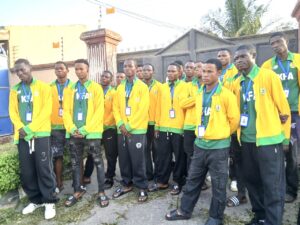
The Nigerian U-17 and U-20 teams are another tragedy in this comedy of failure. We used to be the fear of the world , now we are the farce. At the WAFU B tournament, our U-17 team was an embarrassment. At the FIFA U-20 World Cup, we were like tourists with jerseys.
The problem is not talent , Nigeria produces footballers the way the Amazon produces rain. The problem is the system that suffocates them. Scouting is political. Selection is transactional. Development is accidental. The average young player has no pathway, no mentorship, and no academy that prepares him for the rigors of elite football.
Our football age is a lie. Our fitness is a lie. Our scouting is a lie. In short, Nigeria’s entire sporting culture is a well-organized deceit.
And then there are the Super Eagles , the perpetual “giant of Africa” whose wings have been clipped by complacency. When a team with Europe-based stars struggles to beat Lesotho and Zimbabwe in World Cup qualifiers, you know the spirit of mediocrity has become national policy.
Every time we fail, the NFF announces a familiar ritual: “We are going back to the drawing board.” The question is , who keeps stealing this drawing board? Because for decades, we have been drawing circles around failure, and yet, we act surprised when we end up in the same place.
We don’t learn. We don’t reform. We recycle the same administrators, the same excuses, the same prayers.
Football is not an isolated tragedy. It is a mirror of our national character. A society that lies to itself cannot build anything functional. We lie about statistics. We lie about progress. We lie about merit. And football, being a faithful child of society, has become a monument to deceit.
We celebrate mediocrity with nationalistic zeal. We say “we move” after every disgrace. We have become immune to shame , professional sufferers of failure.
In The Burnt-Out Case, Querry discovers that true healing begins when you stop lying to yourself , when you confront the rot and begin again from truth. Nigeria has not yet reached that point. We are not burned out enough to seek honesty. We still cling to false hope, like a drunk to his last bottle.
Until we admit that our football is not sick but dying , that our administrators are not misguided but corrupt , and that our structure is not weak but non-existent, there will be no redemption.
We will keep losing to Lesotho. We will keep blaming luck. We will keep going “back to the drawing board.”
And one day, when the rest of Africa is soaring, we will still be here, in our leper colony of deceit, clapping for mediocrity ,the burnt-out case that refuses to heal.
About The Author