pristinegist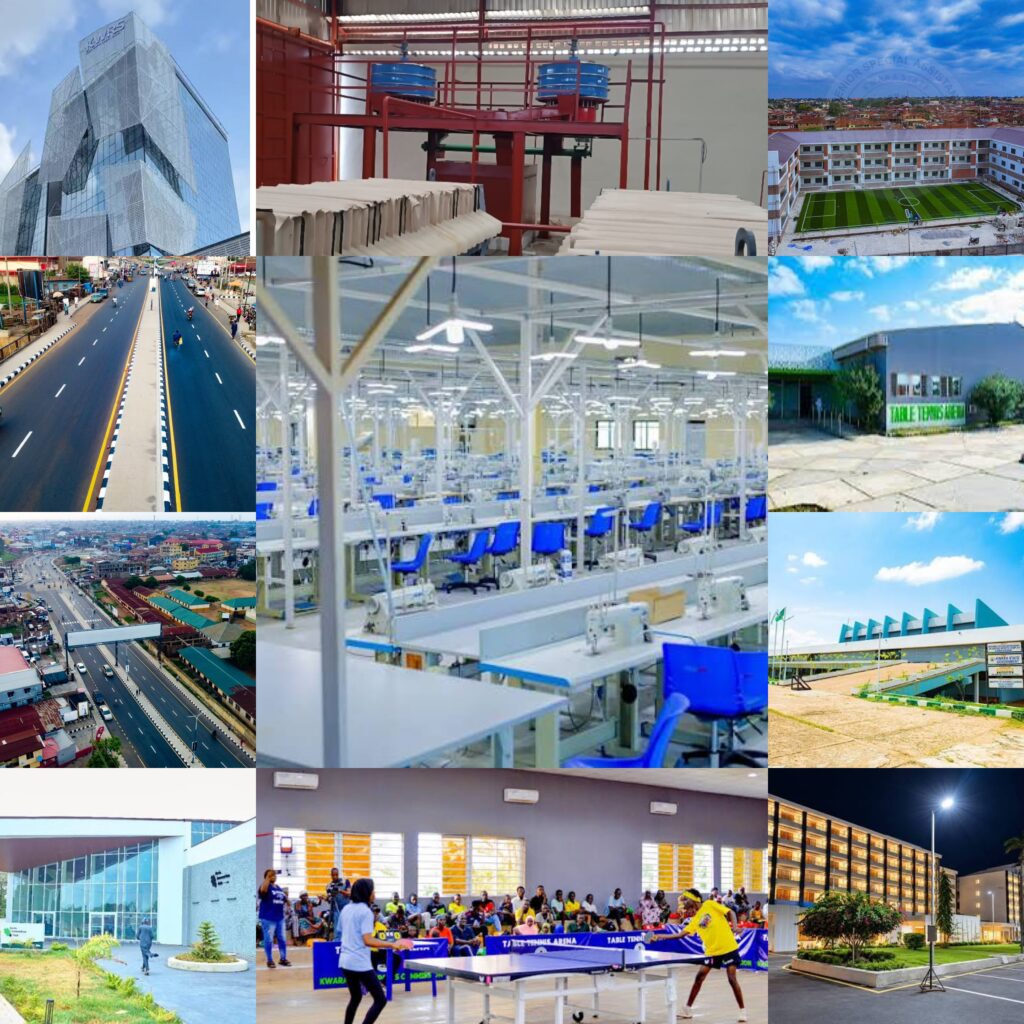
Kwara is changing. The question now is not whether to start again, but how to build higher on the foundation already laid.
By Olaide Ahli
There is a point at which politics must give way to reality.
For fairness, the development trajectory of Kwara State under Governor Abdulrahman Abdulrazaq deserves serious consideration. The argument is not that everything is perfect or that every policy has been universally accepted. Rather, it is that the state has witnessed a sustained programme of infrastructure renewal, institutional development, human-capital investment and economic initiatives that deserve to be assessed on their merits.
Slowly but steadily, Kwara is moving forward.
The Kwara State inherited by the AbdulRazaq administration in 2019 is not exactly the same Kwara of today. The evidence of change can be found in roads and public infrastructure, education, healthcare, technology, agriculture, social investment and other areas of public administration.
In presenting the 2026 budget, the administration committed almost two-thirds of the proposed expenditure to capital projects and placed considerable emphasis on completing ongoing projects. The government reported the completion of 38 roads and 29 interlock access lanes, while more than 264 kilometres of roads were at different stages of construction. It also highlighted investments including the Innovation Hub, Revenue House, Indoor Sports Hall, International Conference Centre, Kwara Hotel, health facilities, universities and agricultural projects.
These are not merely numbers on a budget document. They represent public investments whose full benefits may take years to mature.
And this brings us to the bigger question: What happens to these investments when an administration changes?
Development should not start from zero every four years
One of the greatest challenges of governance is discontinuity.
When every new administration treats the projects and policies of its predecessor as political property rather than public assets, development suffers. Projects are abandoned, priorities are changed and public resources may be spent repeatedly on redesigning or restarting initiatives that could otherwise have been completed.
There is an old saying: “A river that forgets its source will soon run dry.”
Governments change, but the state remains.
A new administration should therefore not inherit only government offices and files. It should inherit the responsibility to protect worthwhile public investments, complete viable projects, improve existing policies and introduce new ideas where necessary.
That is the essence of continuity.
It does not mean blind continuation. It means continuing what works, correcting what does not work and expanding what delivers value to the people.
Why SYD becomes important to the continuity conversation
The emergence of Rt.Hon.Engr Yakubu Danladi-Salihu (SYD), the APC governorship candidate for 2027, places the question of continuity directly at the centre of the political conversation.
Danladi-Salihu has publicly stated that, if elected, his administration would sustain and improve upon the developmental strides of Governor AbdulRahman AbdulRazaq. He has also served as Speaker of the Kwara State House of Assembly, giving him direct experience with the legislative processes through which government programmes and budgets are authorised.
That creates several areas in which continuity could be pursued.
1. Completing ongoing infrastructure
A continuity administration could prioritise the completion of viable roads, public buildings and other infrastructure already under construction rather than unnecessarily abandoning them for entirely new projects.
The principle is simple: finish what is useful before starting what is merely new.
As the proverb goes, “It is better to complete one road than to begin ten roads and finish none.”
2. Protecting long-term capital investments
Projects such as technology infrastructure, healthcare facilities, educational institutions, industrial facilities and other capital investments require sustained funding and management beyond a single budget cycle.
SYD has publicly promised to build on the AbdulRazaq administration’s achievements rather than abandon them.
3. Maintaining fiscal discipline and project-focused budgeting
AbdulRazaq’s 2026 budget placed 65.98% of proposed expenditure on capital expenditure, with project completion identified as a major priority.
A successor committed to continuity could maintain the discipline of linking public expenditure to measurable development priorities while adjusting allocations to emerging needs.
4. Expanding the economic foundation
The Innovation Hub, agricultural investments, industrial projects and other initiatives are intended to broaden Kwara’s economic base.
The next administration could build on those foundations by attracting additional private investment, supporting local businesses, strengthening value chains and creating more opportunities for young people.
“When we build on the foundation already laid, the house rises faster.”
5. Sustaining education and healthcare investments
Development is not measured only by roads and buildings. Education and healthcare require consistent investment, maintenance and policy continuity.
The AbdulRazaq administration has highlighted investments in universities, schools and healthcare facilities. A successor could preserve those investments while addressing gaps that emerge through experience and changing population needs.
6. Preserving institutional knowledge
SYD’s experience in the legislature is also relevant to this conversation. AbdulRazaq has argued that Danladi-Salihu was part of the administration’s legislative process and that projects were appropriated under his leadership as Speaker.
This means the continuity argument is not simply about political affiliation. It can also be examined in terms of institutional familiarity with the policies, budgets and projects already underway.
7. Taking development to more communities
Continuity should not mean concentrating development in places that have already benefited.
Danladi-Salihu has said his proposed administration would extend development further into rural communities.
The logical next phase should therefore be to consolidate existing gains while ensuring that more communities benefit from infrastructure, education, healthcare, economic opportunities and social programmes.
8. Improving rather than merely preserving the status quo
Perhaps the most important point is that continuity should not be confused with stagnation.
Continuity is not “keep everything exactly as it is.”
It is the ability to say: this works, let us strengthen it; this needs improvement, let us improve it; this project is valuable, let us complete it; and this policy is no longer adequate, let us replace it with something better.
That is how serious institutions grow.
The bigger issue: Kwara beyond personalities
Kwara’s political debate should ultimately be larger than individual politicians.
The question should be: What kind of development path should the state pursue over the next decade?
If a government spends years building infrastructure, strengthening institutions and establishing economic initiatives, the state should not lose those gains simply because leadership changes.
A new governor should inherit a foundation, not a blank sheet of paper.
As another African proverb reminds us, “If you want to go fast, go alone; if you want to go far, go together.”
Kwara cannot afford to repeatedly start again.
The state needs a development culture in which administrations build on one another, public projects are treated as public assets, policies are evaluated on evidence and citizens hold every government accountable for delivering results.
Governor AbdulRahman AbdulRazaq’s years in office have therefore opened an important conversation about what comes next.
The continuity argument around SYD is ultimately an argument about consolidation, completion and further development: preserving useful achievements, finishing worthwhile projects, correcting shortcomings and creating a stronger foundation for the next generation.
A good foundation should not be demolished simply because the person who laid it has left the building site.
The responsibility of the next administration should be to build the next floor.
And for Kwara, the real measure of political maturity will be whether the state can move from one administration to another without losing the development momentum that its people have invested in.
My fellow Kwarans, let us choose continuity, stability and sustained development. Vote APC and support the progress we have started, rather than allowing self-serving interests and political distractions to derail our collective journey.
Together, let us keep Kwara moving forward.
I’m Olaide Ahli, the president of Kwara Development Group (KDG)
About The Author