pristinegist
By Olaide Ahli
The Kwara State House of Assembly member representing Owode/Onire Constituency, Hon. Rukayat Shittu, has made a strong case for Ilorin to be considered for a future refinery investment by Alhaji Aliko Dangote and other major investors, arguing that the city has the strategic location and emerging business environment required to support large-scale industrial development.
Shittu, the youngest member of the Kwara State House of Assembly and one of the youngest lawmakers in Nigeria, made the case following her invitation to the President of Dangote Group, Alhaji Aliko Dangote, to consider Ilorin for a future refinery project.
She acknowledged that Lagos enjoys significant advantages because of its coastline, deep-water access and proximity to international shipping routes, but argued that Ilorin should not attempt to compete with Lagos by replicating its coastal model.
Rather, she said, Ilorin could develop a complementary role as an inland refining, energy and distribution hub serving Nigeria and the wider African market.
“Lagos has the coastline, deep water access and proximity to international shipping. It is therefore naturally positioned to remain a major refining and export hub for Europe, Asia, the Americas and the wider Atlantic market,” Shittu said.
“Ilorin can complement that position by becoming an inland energy and refining hub focused on Nigeria and the African continental market.”
AbdulRazaq’s Transformation Strengthens Ilorin’s Investment Appeal
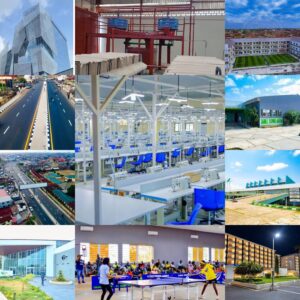
Shittu also pointed to the development strides of the administration of Governor AbdulRahman AbdulRazaq as an important reason why Ilorin should now be taken seriously as a destination for major private-sector investment.
She said the administration’s emphasis on infrastructure development, improved connectivity, urban renewal and creating a more conducive environment for businesses has strengthened Ilorin’s position as an emerging investment destination.
According to her, the changing face of Ilorin under AbdulRazaq means that discussions about major industrial investments in the city should no longer be viewed through the limitations traditionally associated with an inland location.
“The work of Governor AbdulRahman AbdulRazaq has significantly changed the conversation about Ilorin as an investment destination,” Shittu said.
“Today, we are talking about a city that is increasingly positioning itself as a business-friendly environment, strategically located between the South and the North. That is an advantage we must begin to market aggressively to major investors.”
She noted that improved infrastructure and connectivity across the state have strengthened the city’s links with major commercial centres and markets, adding that a more business-friendly environment could provide the foundation for attracting large-scale industrial projects.
Shittu said the objective should not simply be to attract a refinery, but to use such an investment as an anchor for a much wider industrial ecosystem capable of creating jobs, stimulating local businesses and attracting technical expertise.
Why Ilorin Can Compete
The lawmaker argued that a refinery does not necessarily have to be located on the coast to receive crude oil.
She identified dedicated crude pipelines from producing regions, expanded national petroleum infrastructure, strategic crude storage facilities and connections to multiple supply corridors as possible mechanisms for supplying an inland refinery.
Rail, she added, could also serve as a supplementary logistics option where commercially viable.
“A refinery should be located not only close to crude, but also close to its customers,” she said.
It is this consideration, according to Shittu, that gives Ilorin a potentially strong strategic advantage.
Ilorin sits between Nigeria’s southern and northern markets and could potentially serve North Central Nigeria, the North and neighbouring African markets, while retaining access to the South-West.
Shittu argued that locating refining capacity closer to major consumers could reduce the need to transport large volumes of refined petroleum products over long distances from coastal refining centres into the interior.
She said this could potentially generate savings in transportation and distribution while reducing logistics risks, road congestion and product evacuation challenges.
Proposed Ilorin Energy and Industrial Corridor
Beyond the refinery itself, Shittu proposed the development of what she described as an Ilorin Energy and Industrial Corridor.
She envisaged a major refinery serving as an industrial anchor for petrochemicals, gas processing, fertiliser production, power generation, industrial manufacturing, storage, engineering services, logistics, aviation fuel, lubricants and other energy-intensive industries.
According to her, such an ecosystem could transform Ilorin from a predominantly commercial and administrative centre into a major inland industrial and energy hub.
“Instead of transporting huge volumes of refined products from the coast deep into the interior, Nigeria could bring refining capacity closer to the consumers,” she said.
She further argued that the broader opportunity was to position Ilorin as an inland energy gateway connecting Nigeria’s major markets with the wider African market.
Lagos and Ilorin Can Play Different Roles
Shittu stressed that her proposal was not an attempt to diminish Lagos’s importance in Nigeria’s energy and maritime economy.
Rather, she said, Nigeria could benefit from having complementary refining and distribution hubs serving different markets.
“Lagos can remain Nigeria’s major coastal refining and global export hub. Ilorin can develop as an inland refining, distribution and African market hub,” she said.
“One faces the ocean. The other faces the continent. That is not duplication. That is diversification.”
She maintained that diversification of critical energy infrastructure could help Nigeria reduce systemic risks and logistics costs while strengthening the country’s capacity to supply different regions efficiently.
Invitation to Dangote and Other Investors
Shittu said her invitation to Alhaji Aliko Dangote was informed by his record of demonstrating what Nigerian private capital can achieve through projects of global significance.
However, she stressed that the proposal should not be limited to Dangote.
She called on other Nigerian industrialists, indigenous petroleum companies, international investors, infrastructure funds and private-sector consortia to also explore the opportunity.
“Kwara is open to all serious investors willing to build productive energy infrastructure,” she said.
“Let them come. Let the engineers study it. Let the economists model it. Let the investors test the numbers. If the numbers work, Ilorin is ready.”
The lawmaker identified land availability, Ilorin’s strategic location, access to major markets and the state’s emerging infrastructure ecosystem as potential advantages for large-scale industrial investment.
She said Kwara’s ambition should be to transform its geographical position into sustainable industrial wealth.
Reiterating her invitation to Dangote, Shittu said the proposal was not based on the assumption that Ilorin had no infrastructure or logistical challenges.
Rather, she said, major industrial projects are often built by identifying challenges that can be commercially and technically solved.
“Alhaji Dangote, come and look at Ilorin. Not because Ilorin has no challenges, but because every great industrial project begins by solving challenges that are worth solving,” she said.
Shittu concluded that Ilorin might not become another Lekki, but could develop a distinct identity as Nigeria’s inland energy gateway to Africa.
Shittu highlights AbdulRahman AbdulRazaq’s business-friendly environment, improved infrastructure and Ilorin’s strategic location as key advantages for major industrial investment.
About The Author