pristinegist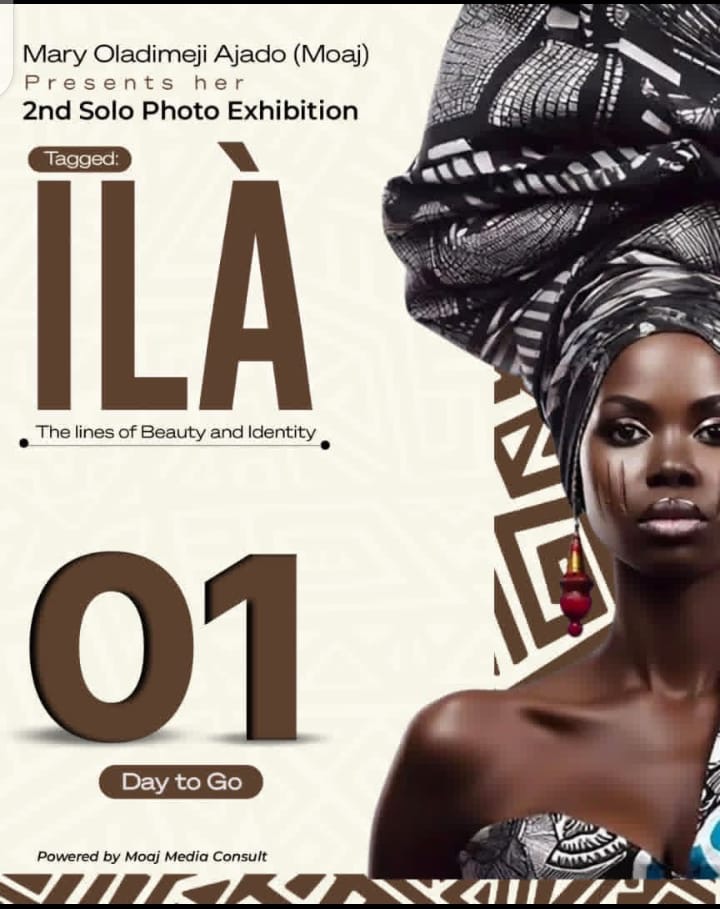
– as Moaj Media holds second Photography Exhibition Sept. 19
Mary Oladimeji Ajado, popularly known as Moaj Media, has explained the motivation behind her forthcoming photography exhibition, “ILA: The Lines of Beauty and Identity,” saying the project is aimed at documenting and preserving the history and identity associated with Yoruba tribal marks.
Ajado, who described Moaj Media as an umbrella platform for photography, visual storytelling, brand development, education and cultural preservation, said the exhibition will take place on Saturday, September 19, 2026, at the Ilorin Innovation Hub.
The exhibition follows the success of last year’s edition, which focused on “Emblems of Ilorin Matrimony,” but this year’s project will centre on Yoruba tribal marks and the different identities they once represented across various Yoruba communities.
According to Ajado, photography provides an effective means of preserving aspects of culture that are gradually disappearing from everyday life.
“I’m somebody that believes in actively, consciously, intentionally educating and preserving. And I discovered that photography is one beautiful way to actually preserve culture, to educate and preserve culture,” she said.
The Moaj Media founder explained that although tribal marks are no longer widely practised and there are advocacy efforts against the practice, the historical significance of the marks cannot simply be ignored.
She noted that there was a time when tribal marks played an important role in identifying people and their roots, adding that the gradual disappearance of the marks has also made it increasingly difficult for younger generations to recognise the different patterns associated with various Yoruba communities.
“We cannot deny the fact that there was a time that some people wore those marks, and it should be preserved. It’s some of the things that makes us our identity at a time. I mean the Yoruba people,” she said.
Ajado further explained that one of the major objectives of the ILA exhibition is to provide a visual representation of the different tribal marks, including marks such as Abaja and Bamu, which she said many people can no longer identify.
She revealed that during the research and documentation process, some people who still carry tribal marks were unable to identify the specific names or meanings of the marks on their faces.
“Some of the people we met while working on this, we asked them, ‘Oh, what’s the name of your mark?’ ‘Ah, I don’t know.’ ‘Oh, I just know that my parents gave me mark,’” she recounted.
The photographer said the exhibition is therefore intended to document the appearance and identity of the different marks while helping people understand the geographical and cultural backgrounds associated with them.
Ajado recalled how people in the past could identify the roots of individuals simply by looking at the lines on their faces, noting that tribal marks once served as an important means of identifying where people came from.
“These were lines that were associated with identity. They draw who they are. You can pinpoint. I remember growing up, my mom would look at somebody and tell exactly where the person is from,” she said.
She explained that the knowledge of tribal marks enabled older generations to identify people from communities such as Oyo, Owu and other Yoruba regions, adding that such knowledge is gradually fading away.
Ajado also compared the need to preserve the history of tribal marks with the preservation of relics associated with slavery.
She noted that although slavery has been abolished, relics from the era, including chains, boats and buildings, are still preserved as historical evidence for future generations.
According to her, the same approach should be applied to cultural practices that are no longer common, stressing that documenting tribal marks does not amount to advocating for their continued practice.
“I’m not advocating that parents should be giving their children tribal marks now. That’s not what I’m saying. What I’m saying is a people once wore those things, and it won’t be bad to actually document it,” she explained.
The exhibition will therefore seek to answer questions about how different Yoruba communities wore their marks and the meanings attached to them, with Ajado specifically mentioning Oyo, Ife and Ondo among the communities whose traditions she hopes to document.
While acknowledging that the government has a role to play in preserving cultural heritage, Ajado said individuals also have a responsibility to actively document and educate others about their history.
“The government cannot stricto sensu educate your children. We have the role to play, and that is one of the things I am doing,” she said.
She added that her decision to use photography for cultural preservation was part of a broader effort to ensure that important aspects of Yoruba heritage are not completely lost.
Ajado also addressed the continued existence of tribal marks, arguing that while the traditional methods of creating them may have raised concerns about safety and hygiene, the conversation could include modern approaches to cultural expression.
She compared tribal marks with tattoos and piercings, suggesting that modern methods could potentially be explored by people who voluntarily wish to preserve the practice without relying on the potentially harmful methods used in the past.
“If people have tattoo, why can’t they have tribal mark?” she asked.
However, Ajado maintained that the central focus of ILA: The Lines of Beauty and Identity is not to encourage people to acquire tribal marks, but to ensure that the history, appearance and cultural significance of the marks are documented before they completely disappear from public memory.
Through the exhibition, she hopes to create a visual record that will allow present to and future generations to understand how tribal marks once served as symbols of beauty, identity, heritage and geographical origin among Yoruba people.
About The Author